
This article is about:
01
General Overview
Avalanches are closely linked to weather and climate. Ongoing climatic changes are influencing not only the frequency and intensity of avalanche events, but also their spatial and temporal patterns.
For avalanche commissions acting as local risk managers, this entails a continuous need to adapt to changing boundary conditions. They are increasingly confronted with complex and evolving scenarios that require adjustments in both assessment and prevention strategies. But how is the avalanche phenomenon itself evolving? And what specific changes can avalanche commissions expect to face?
To assess the evolution of avalanche activity, it is essential to understand ongoing changes in weather and climate. A key factor in this context is the geographical redistribution of precipitation – not only shifts in the vertical snowline. Projections suggest a decrease in precipitation in southern Europe, while increases are expected in the north. The Alps thus lie in a transitional zone between these opposing trends. Moreover, climate change is not only associated with a redistribution of precipitation; according to the IPCC, it is also linked to an increasing frequency of extreme weather events.
However, in assessing the evolution of avalanche hazard, the form in which precipitation occurs is decisive – whether it falls as liquid precipitation (rain) or as solid precipitation (snow). In this regard, a rising snowline is highly likely. Marty et al. (2017) concluded that, by the middle of this century, a continuous snow cover during the winter months is expected to occur predominantly above approximately 2.000 m. For avalanche commissions, this would imply a decreasing frequency of avalanches affecting settlement areas. Such a trend has already been observed, for example, in the French Alps, where large avalanches have exhibited progressively shorter runout distances (Eckert et al., 2010).
02
Change in snow Avalanche Activity: Case study from the Swiss Alps
(Study by Mayer et al 2024)
The study by Mayer et al. (2024) aims to quantify future changes in the duration, spatial distribution, and depth of the snow cover in order to derive potential developments in avalanche activity.
The methodological approach consists of applying various climate scenarios and simulating their impacts using snowpack models. Based on these simulations, potential trends in avalanche activity are identified. The underlying data are derived from time series collected by automatic weather stations at multiple sites across the Swiss Alps. Some of the analyzed locations are situated in the border region of the Euregio Tyrol–South Tyrol–Trentino, which allows for a strong comparability of the study results with expected future avalanche activity in this area.
Overall, an increase in temperatures can be expected. In quantitative terms, the winter zero-degree level is projected to rise from around 800 m to approximately 1.800 m. Consequently, the elevation of a continuous snow cover will also shift towards higher altitudes. At the same time, this leads to a reduced likelihood of avalanches occurring at lower elevations.
All model simulations indicate a consistent trend: a decrease in dry avalanches accompanied by an increase in wet avalanches. The rise in wet avalanches is expected primarily at elevations above approximately 2.300 m (around 5–20%), while a significant decrease (around 15–20%) is projected below this altitude. The latter is likely attributable to the overall reduction in snow cover as well as the already high current activity of wet-snow avalanches. Notably, the decrease in dry avalanches and the increase in wet avalanches partly offset each other. As a result, the overall change amounts to only a moderate decline in total avalanche activity of roughly 10%. In addition, considering the other trends, avalanche activity is expected to shift towards higher elevations. Furthermore, the transition from dry to wet avalanches suggests a tendency toward smaller events, which are generally associated with shorter runout distances.
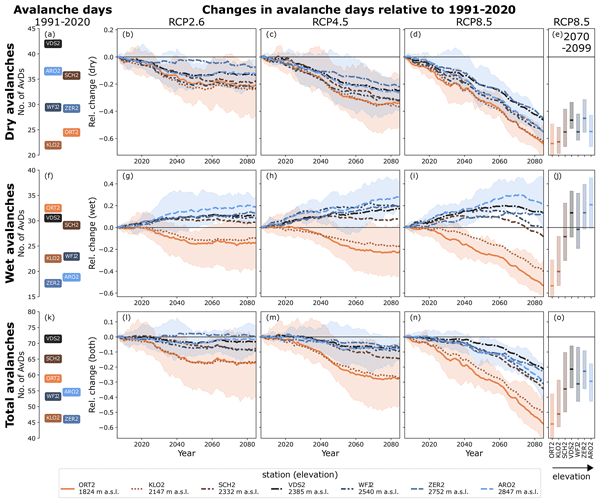
According to Mayer et al. (2024): expected changes in avalanche activity of dry avalanches (b–e), wet avalanches (g–j), and their combination (Total avalanches: i–o) for the current century under three different emission scenarios (RCP2.6, RCP4.5, and RCP8.5).
Left (a–f–k; Avalanche Days): The y-axis shows the number of days classified as potential avalanche days (No. of AvDs) for the period 1991–2020 at seven selected automatic weather stations in the Swiss Alps.
Middle (Changes in avalanche days relative to 1991–2020): The x-axis refers to the year, while the y-axis shows the relative change in potential avalanche days over time. If the line lies in the positive range, it indicates a relative increase in avalanche activity; in the negative range, it indicates a decrease. The differently colored lines correspond to the weather stations shown on the left.
Right (e–j–o): Reference to the dispersion of avalanche days in the period 2070–2099.
Summary (based on Mayr et al 2024)
Climatic development:
- Significant increase in temperature
- Rise in the winter zero-degree line: approx. 800 m → 1.800 m
- Decreasing avalanche activity at lower altitudes
Development in avalanche activity:
- Decrease in dry-snow avalanches
- Increase in wet-snow avalanches
- Overall slight decline in total avalanche activity (~ −10%)
03
What lies ahead for avalanche commissions?
Changes in avalanche activity have a direct impact on the assessment processes of avalanche commissions and, consequently, on the measures they are required to implement. In general, the fundamental dynamics of dry and wet avalanches are not expected to change substantially. However, it must be anticipated that wet-snow avalanches will increasingly occur during periods in which they have traditionally played only a minor role. As a result, wet-snow conditions will need to be considered throughout the entire assessment period, rather than being confined primarily to late winter.
The expected trend toward more frequent wet-snow avalanches is partly associated with shorter runout distances, which can generally be viewed as a positive development. At the same time, it is important to recognize that, despite their typically lower flow velocities, wet avalanches may pose an increased damage potential due to their higher density. In addition, it will be necessary to evaluate whether existing protection structures remain adequate under changing conditions and can continue to provide their full protective function.
The study presented above clearly indicates a shift in this direction. Nevertheless, recurring extreme weather events must not be overlooked. Such events are typically responsible for the most critical civil protection situations and remain particularly challenging for avalanche commissions. Importantly, these events may still be accompanied by intense dry-snow avalanche activity.
Literature
Eckert, N., E. Parent, R. Kies et al. (2010): A spatio-temporal modelling framework for assessing the fluctuations of avalanche occurrence resulting from climate change: application to 60 years of data in the northern French Alps. Clim. Change, 101(3-4): 515-553.
IPCC Sixth Assessment Report 2021; Chapter 11: Weather and Climate Extreme Events in a Changing Climate
Marty, C., S. Schlögl, M. Bavay & M. Lehning (2017): How much can we save? Impact of different emission scenarios on future snow cover in the Alps. Cryosphere, 11(1): 517-529.
Mayer, S., Hendrick, M., Michel, A., Richter, B., Schweizer, J., Wernli, H., & van Herwijnen, A. (2024). Changes in snow avalanche activity in response to climate warming in the Swiss Alps. WSL Institute for Snow and Avalanche Research SLF.
Cover picture: Below-average snow cover conditions in Val Passiria in mid-January 2026 © Lukas Rastner | snow institute