DEEP

Act: recommendations, measures, and communication channels

05.12.2025

Under certain conditions, avalanches can pose such a high level of risk to people and property that the implementation of measures becomes necessary. The type and extend of those measures depend on the specific circumstances of each situation.

This article is about:

01

Course of action

If the assessment of the avalanche situation indicates risk to people or property, this hazard requires active intervention. In the context of avalanche commissions, however, taking actions does not mean actively carrying out the measures, but rather issuing recommendations for actions.

As an advisory body to decision-makers, avalanche commissions do not assume operational responsibilities during actual emergency operations. For example, they are not the ones who physically implement a road closure. Their primary role is to provide well-founded, expert recommendations on the basis of which the risk owners then carry out the necessary operational measures.

To understand when action is necessary and when it is not, working with “potential scenarios” has proven extremely effective in practice. In this approach, different measures are prepared for various possible situations so that they can be implemented quickly as soon as those situations arise.

In practical terms, this means preparing so-called if-then decisions that automatically lead to specific measures once certain parameters are met. Another important aspect is that, in the professional discussion about optimal measures, various courses of action should always be identified and evaluated in terms of their effectiveness. If there is only a single option available, the scope for action is necessarily very limited. Depending on the situation, the following measures (recommendations) may be considered, all of which contribute to risk reduction:

  • Informing the mayor regarding the current situation
  • Issuing public warnings/information (e.g., activating the avalanche warning lights or providing notices about hazardous areas)
  • Conducting ongoing or intensified field observations(e.g., ground surveys on foot or by vehicle, aerial and drone surveys, monitoring of glide-snow areas)
  • Artificial triggering of avalanches;
  • Controlled (supervised) travel on ski slopes, roads, and trails (if necessary, in convoys)
  • Temporary closure of roads and all types of transportation routes, ski slopes, cross-country trails, toboggan runs, winter hiking trails, or other areas
  • Temporary evacuation/clearing of buildings and settlements
  • Preventive measures due to limited visibility
  • Other measures

EXCURSE: How to reduce the risk?

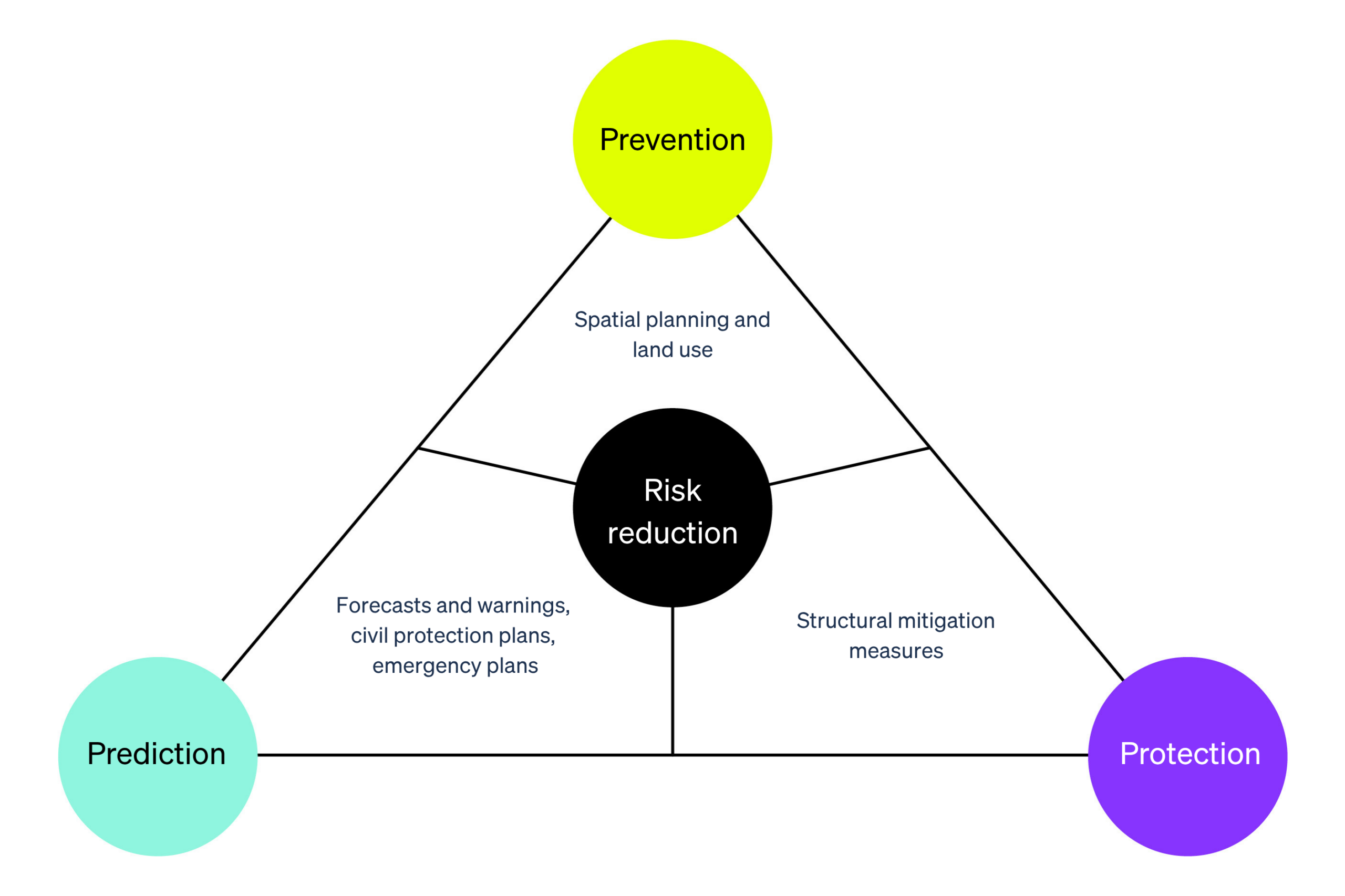
Risk reduction in general is based on three fundamental factors:

  • Hazard prediction: identifying conditions that may trigger an event using monitoring systems, models, and field observations.
  • Prevention: reducing the likelihood of the event and limiting potential damage through structural measures, regulations, and good land‑management practices.
  • Protection: limiting damage when an event occurs through structural defences, warning systems, and emergency plans.
Risk reduction factors diagram: the diagram illustrates the interdependence between prevention, preparedness, and protection, highlighting how the integration of structural measures, land-use planning, and warning systems is essential to minimizing the impact of adverse events on the territory. © snow institute

Mitigation measures, in their full scope, rely on a set of strategies grouped into two main categories – structural and non structural – which can in turn be classified as active or passive (see “Avalanche commissions as part of the disaster resilience”).

The justification behind the measures taken must be transparent and sufficiently detailed. All relevant information regarding the decision or the decision-making process, as well as the persons and institutions involved, must be documented. The date of the next meeting should be noted, particularly when the avalanche situation is critical.

Proper recording and documentation of the work of an avalanche commission are essential. On the one hand, they serve as evidence of a careful and diligent approach; on the other hand, the accumulated documentation over time enables a more accurate assessment of avalanche related issues.  Securing decisions also ensures traceability of actions in the event of damage. Put simply, it is far better to have a well-documented mistake than to face the accusation of having taken no action at all.

To ensure that ongoing documentation and record-keeping can be carried out as efficiently as possible, it is advisable to work on a structured manner and make use of appropriate tools (e.g., risiko.report “risk.report manual”). However, the specific method chose to guarantee the traceability of the commission’s work ultimately lies at the discretion of each avalanche commission. In most cases, civil protection authorities at the regional or national level provide systems that are tailorated to the needs of avalanche commissions.

02

Communication

Since the competence of avalanche commissions does not include the physical implementation of measures but only the recommendation of such measures, appropriate communication must be forwarded to the decision-makers or responsible institutions. In this respect, thorough documentation and logging is again of great importance.

Typically, a commission will forward a recommendation to the mayor, however, it is also possible to provide guidance to entities outside the municipal jurisdiction. A typical example of this would be recommended measures in ski resorts.

03

Evolution of the hazard situation and monitoring of measures

Whether measures that have been taken need to be tightened, extended in duration, or can be lifted is one of the key questions for avalanche commissions. The focus is not only on the current situation, since the recommended measures must remain valid at least until the next commission meeting of the next assessment. For appropriate measures to be taken to prevent danger to people or property from avalanches, it is essential that the avalanche commission stays one step ahead in its assessment (risk estimation).

Critical situations usually become apparent days in advance— valuable time that allows for appropriate action. In this context, forecasts and maps from the official meteorological service, including all relevant weather data, are of paramount importance. On days with high avalanche danger, it is often no longer possible to implement effective measures due to unfavorable conditions (e.g., severe weather), or very drastic actions (e.g., evacuation) must be taken that could have been avoided with timely action.

Clearly, it is also of significant practical importance to correctly assess when the situation is easing, as unnecessary measures can lead to a loss of public acceptance and damage the credibility of the avalanche commission.

The following points are intended to help assess developments, although the values mentioned must be adapted to the specific assessment areas.

Criteria for evaluation the temporal evolution of avalanche danger © Avalanche Commissions Tyrol| snow institute
04

Control

The final step in a strategic approach to avalanche commission work is the verification, as it is essential to ensure that the measure taken are actually effective. If the desired effects are achieved, the commission remains prepared to react appropriately should conditions change. Undesirable developments should likewise be identified at an early stage in order to intervene in time. During periods of elevated danger, a denser observation network is definitely recommended.

If, however, the measures do not lead to the intended results, the process must be repeated from the beginning. In particular, when closures and evacuations are in place, it is necessary to continuously check whether they are still appropriate, whether they need to be expanded, or whether they can be lifted.

Cover Picture © Jakob Schwarz | snow institute